Ambassador John L. Loeb, Jr.
May 2, 1930 - August 5, 2026
Distinguished Patriot Award 1993
Honorary President 2009
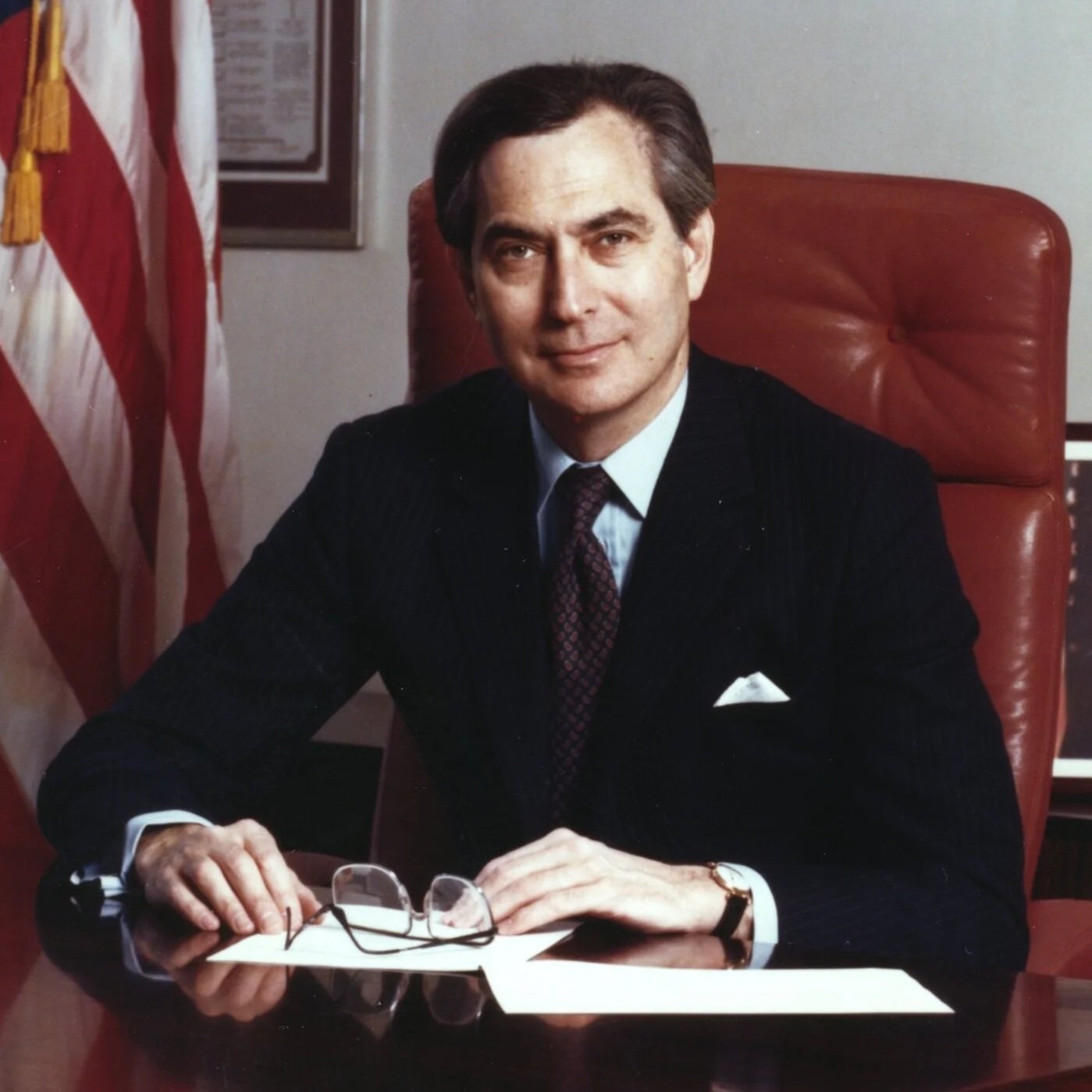
Ambassador Loeb at his desk in Copenhagen
Ambassador John Langeloth Loeb Jr. became a member of Sons of the Revolution℠ in the State of New York, Inc. in April 1975 through his patriot ancestor Jacob Phillips who served in the South Carolina Militia in 1781. Ambassador Loeb had long been devoted to the Society's Fraunces Tavern® Museum.
As recounted in An American Experience, Adeline Moses Loeb (1876-1953) and Her Early American Jewish Ancestors published in 2009 by the Society, Ambassador Loeb and his family came to the aid of the Society at a particularly difficult time following a bomb explosionin part of the Fraunces Tavern complex in 1975. In recognition of the family's contribution to the repair and restoration of the areas impacted by the explosion, the Society named one of its special exhibition galleries after the Ambassador's paternal grandmother, Adeline Moses Loeb. The Gallery was officially opened on October 3, 1979 in conjunction with a special exhibition "The Jewish Community in Early New York, 1654-1800" first proposed by the Ambassador himself.
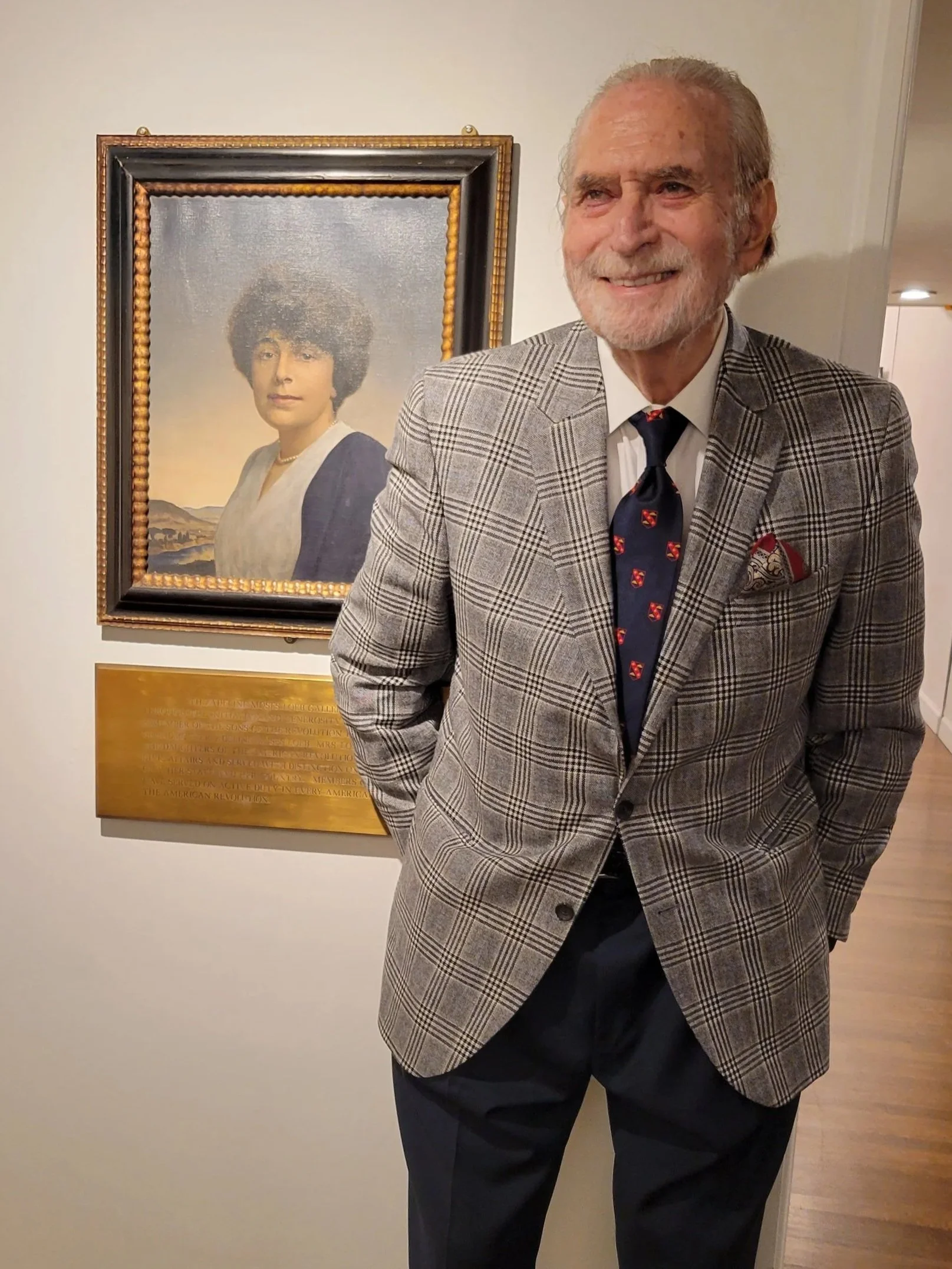
Ambassador Loeb standing next to a portrait of his paternal grandmother Adeline Moses Loeb in the Museum's gallery that bears her name.
Since its opening, the Adeline Moses Loeb Gallery has presented a number of special exhibitions. In the past few years, it has been a key part of the Museum's commemorations of significant anniversaries in American Revolutionary history ― from the 200th anniversary of the return of The Marquis de Lafayette to the 250th anniversary of the signing of The Declaration of Independence. In the fall, the Loeb Gallery will present an exhibition on the nation's First Lady, Martha Washington, centering around her experiences during the Revolutionary War.
In 1993, Ambassador Loeb was awarded the Society’s “Distinguished Patriot Award” and the title of "Honorary President" was conferred upon him in 2009 for his long and distinguished service to and support of the Society and its Fraunces Tavern Museum, amongst his many civil and philanthropic accomplishments. In 2023, a custom-made bookcase was installed in the Museum's Zabriskie Gallery to honor Ambassador Loeb and house books and papers meaningful to the Loeb-Lehman family.
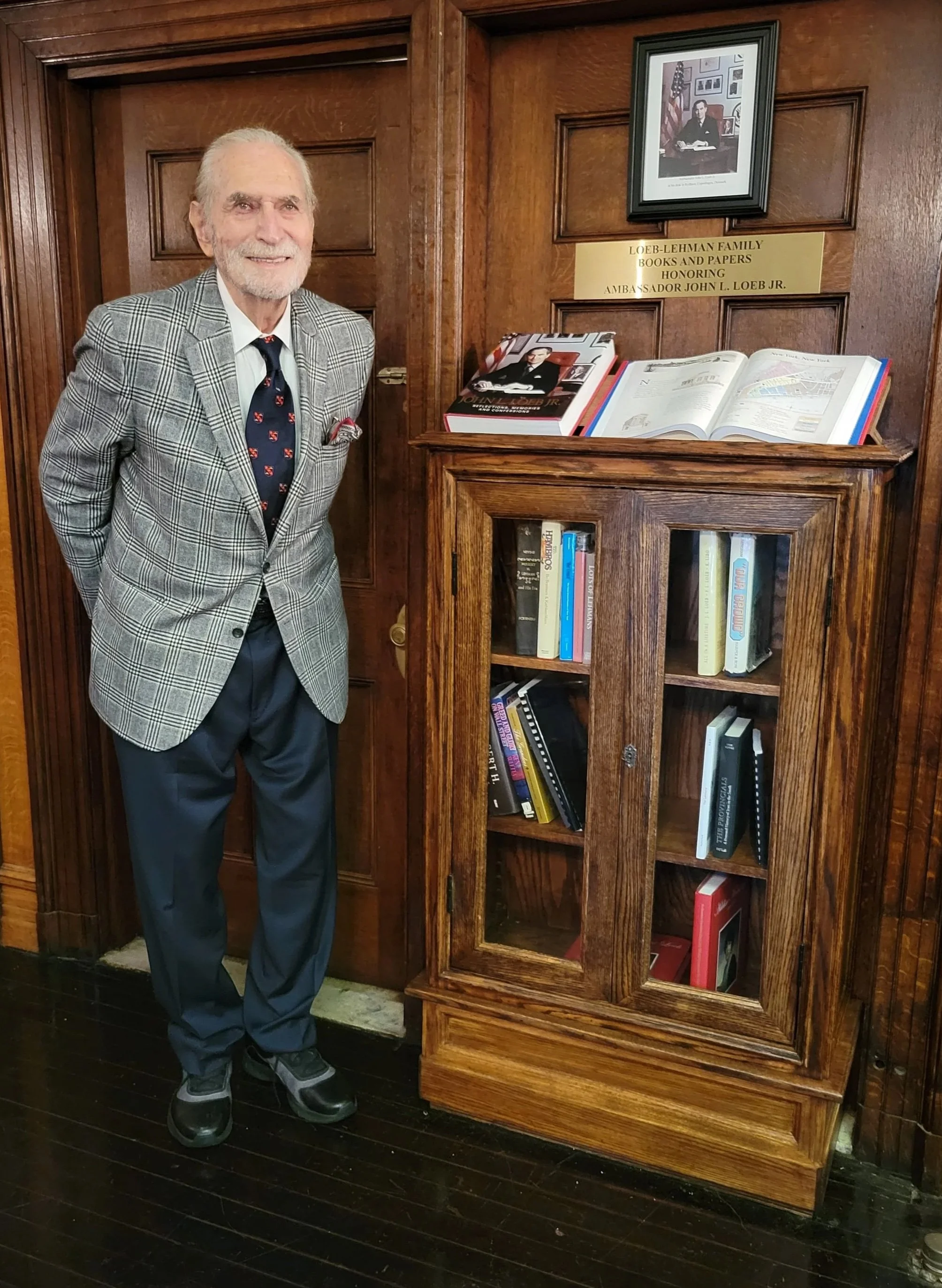
Ambassador Loeb at the dedication of the bookcase in his honor holding books and papers meaningful to the Loeb-Lehman family.
Ambassador John Langeloth Loeb, Jr., a scion of the Loeb and Lehman Wall Street dynasties, was a public servant, financier, author, winemaker, philanthropist, patron of the arts, and, in his final decades, a vigorous champion of the First Amendment.
Born on May 2, 1930, in Manhattan to John L. Loeb and Frances Lehman Loeb, he would later joke that he was born “with two silver spoons in my mouth.” He was among the last of New York City’s German-Jewish elite—“Our Crowd,” as described by historian Stephen Birmingham—and a grandnephew of New York Governor and U.S. Senator Herbert H. Lehman.
Loeb graduated cum laude from Harvard University in 1952, where he was a member of the Lampoon, and earned his MBA from Harvard Business School in 1954. He then served for two years as a First Lieutenant in the U.S. Air Force, stationed at the Air Force Plant Representative Office at Douglas Aircraft Company in Long Beach, California.
In 1957, he joined Loeb, Rhoades, the investment banking firm founded by his grandfather and father, where he spent seventeen years before entering public service and pursuing his own business ventures, including Sonoma-Loeb, a prize-winning winery.
After transitioning into politics, Loeb served as an advisor on environmental issues to New York Governor Nelson Rockefeller, who appointed him Chairman of the New York Council of Environmental Advisors, a position he held from 1970 to 1975. He also served as Chairman of the Holly Sugar Board from 1969 to 1971 and as a director of Metro-Goldwyn-Mayer, Rio Grande Industries, John Morrell & Co., and other corporations.
Politically, Loeb evolved from a Herbert Lehman Democrat to a Rockefeller Republican and later a Reagan Republican during the 1976 and 1980 presidential campaigns. While remaining pro-environment and pro-choice, he was drawn to Ronald Reagan’s fiscal conservatism, charisma, and strong support of Israel. Reagan appointed him U.S. Ambassador to Denmark, where he served from 1981 to 1983.
During his tenure, Danish support for NATO reached unprecedented levels.
In recognition of his diplomatic service, Queen Margrethe II awarded him the Grand Cross of the Order of the Dannebrog. Following his ambassadorship, Reagan appointed him a public delegate to the United Nations’ 38th session (1983–1984), where he served on the Committee on Arms Control under Ambassador Jeane Kirkpatrick. In 2005, the Danish American Society named him “Man of the Year” for his continued promotion of Danish art and his distinguished service.
A passionate collector, Loeb assembled the largest private collection of Danish art outside Denmark, including 150 works of art. In May 2023, the American Scandinavian Foundation honored him with its Cultural Award for his efforts to promote Danish art in the United States.
Loeb devoted the later decades of his life to combating anti-Semitism and advancing understanding of America’s foundational commitment to religious freedom. In 2009, he built the Ambassador John L. Loeb, Jr. Visitors Center at the Touro Synagogue National Historic Site in Newport, Rhode Island. The synagogue, the oldest Jewish house of worship in North America, stands as a testament to early American religious liberty.
Central to the Visitors Center is the story of George Washington’s 1790 letter to the Hebrew Congregation of Newport, written in response to a welcome from Loeb’s ancestor, Moses Seixas, the lay leader of that congregation. Washington’s words remain enduring: that the United States “gives to bigotry no sanction, to persecution no assistance.” Loeb first encountered this letter as an undergraduate, and it left a lasting impression that shaped much of his later work.
To further this mission, he founded the George Washington Institute for Religious Freedom, which from 2010 to 2015 partnered with civic education organizations to train thousands of high school teachers. In 2016, he endowed the Loeb Institute for Religious Freedom and Democracy at The George Washington University to continue and expand these efforts.
“What made John remarkable,” said Michael Feldberg, executive director of the George Washington Institute for Religious Freedom, “was that he never rested on his laurels. Even in his nineties, John remained a tireless advocate for religious freedom… He was unfailingly gentlemanly, gracious, and generous, and his legacy will have meaning for generations to come.”
Loeb’s life intersected with many of the most significant cultural and political figures of the twentieth century, including: Winston Churchill, Salvador Dalí, Dwight Eisenhower, Greta Garbo, Jacqueline Kennedy, John F. Kennedy, Ayn Rand, and Margaret Thatcher.
In 1994, Queen Elizabeth II appointed him Commander of the Most Excellent Order of the British Empire (C.B.E.) for his work with the Winston Churchill Foundation of the United States.
A prolific author and genealogist, Loeb published his memoir, Reflections, Memories and Confessions, in 2018, as well as Ambassador John L. Loeb Jr. Danish Art Collection, in 2005. He co-sponsored Lots of Lehmans, chronicling his family’s history, and authored Adeline Moses Loeb and Her Early American Jewish Ancestors, tracing his grandmother’s lineage to the 1600s. He was a tenth-generation American and a member of Sons of the Revolution in the State of New York.
He also created the Loeb Database of Early American Jewish Portraits, a collection of more than four hundred biographies and images available through the American Jewish Historical Society and the Loeb Visitors Center. A protégé of Kirk Varnadoe and Robert Rosenblum, he supported important scholarship in art history, including Patricia Berman’s In Another Light.
Reflecting his deep love of books and scholarship, Loeb once wrote, “when I write a check to support a book’s publication, I remind myself that seeing a book into print means more to me than owning a Ferrari,” particularly when it related to his passions: American Jewish history, genealogy, and Danish art.
His many civic affiliations included service as a Trustee of the Museum of the City of New York for twenty-eight years, as well as involvement with the American Scandinavian Foundation, Harvard Business School, the Kennedy School of Government, the Winston Churchill Foundation, and numerous other institutions. He was also a member of the Council of American Ambassadors, where he served as Vice-Chairman.
Loeb was a major donor to Newport’s Spring Park and officiated at its groundbreaking in October 2022. The park preserves the historic spring at the center of Newport’s founding in 1639 by settlers seeking religious freedom.
He was a member of numerous social and historical organizations (in addition to Sons of the Revolution in the State of New York), including: the Society of Colonial Wars, the Sons of the American Revolution, the Knickerbocker Club, White’s in London, and Lyford Cay in the Bahamas, as well as clubs and institutions in Palm Beach including the Palm Beach Country Club, the Society of the Four Arts and The Norton Museum.
A lifelong resident of his grandfather Arthur Lehman’s estate in Purchase, New York, Loeb also maintained homes in New York City, London, Aspen, Palm Beach, and Upper Saranac Lake, where he spent cherished summers with his family.
Ambassador Loeb is survived by his beloved wife, Sharon Handler Loeb; his children, Alexandra Loeb Driscoll and husband, and Nicholas Mears Loeb and wife; five grandchildren; his brother, Arthur Lehman Loeb; and his sister, Deborah Loeb Brice.
Reflecting on his life, Loeb said: “I have sought peace in my own heart and explored ways to teach young people how to live with more than tolerance—to live with warmth and understanding of people whose backgrounds are different from one's own.”